

Think Before You Ask “Why?”
September 27, 2026Think Before You Ask "Why?"
Before you ask someone “why,” consider your intent &
what you hope to accomplish.
By Johnny Peters
B Shifter Buckslip, Sept. 29, 2026
Back in the 1990s, a company released a TV ad using captive frogs. Horrific scientific experiments had given the frogs a limited power of human speech. They could each croak out a syllable of the product’s trade name. For legal and safety reasons, I obviously can’t reveal this name. Those of us from that century know. Find a retiree or someone who can’t stop talking about becoming a retiree and ask them. They will know. Do not use search engines or AI. Talk to your elders. Build bonds. Learn. Distract them from their looming demise.
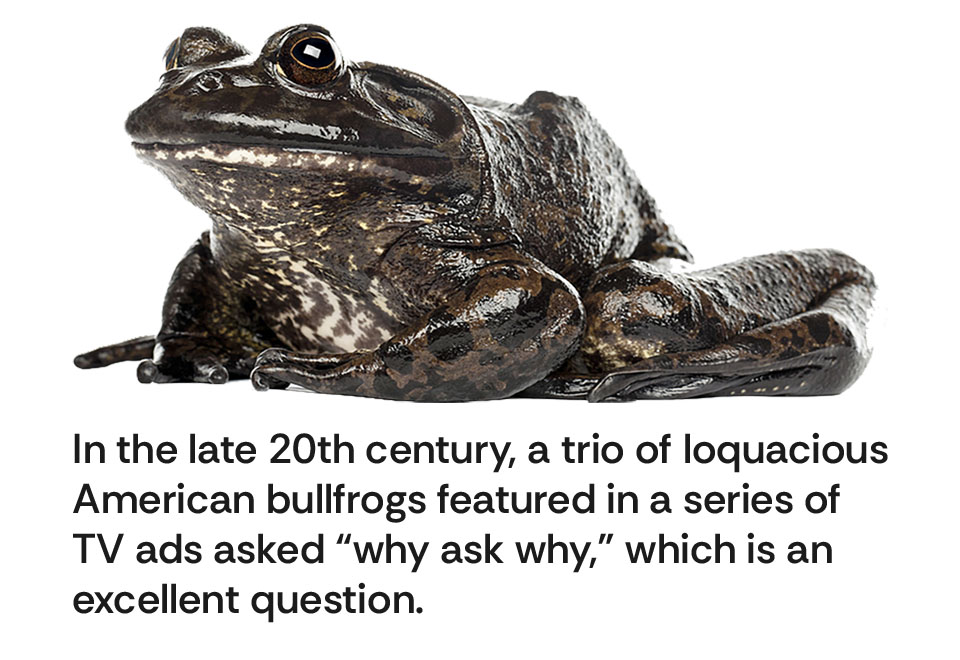
Before the frogs came on the scene, this company dabbled in philosophy to sell one of their other products. They would display the product with a short film depicting its use. At the end of the short film, an unseen poet-philosopher would recite a couplet “Why ask why,” the poem began. The second verse urged us to try the product, which rhymed with “why.” Commercials were cultural events, back then.
This subversive question sold the product, but failed to raise a generation of existentialists. “Why ask why?” is a dangerous question. It can be seen as a call to Bohemianism. And like “Don’t worry, be happy,” it can lead either to becoming a Dionysian party boy or to improving oneself.
Only after reflecting on the ad campaign did I realize the commercial’s deeper meaning. I, myself, was quite taken by the speaking frogs. A young man, I saw only the humor in it, and none of the horror. I completely missed the unseen philosopher’s attempt to prompt introspection. If he lives, I hope he sees this article. I would like him to know he can still reach people across the centuries—that his work didn’t escape notice
What’s Your Motivation?
Considering why you’re doing something is important. I’ve even encouraged it in previous columns. It’s nothing new. What I mean to do here is to ask why we ask why. The obvious answer is to learn, but we all know that asking why can also be an act of defiance or disrespect—a way to ridicule what we see as foolish.
It can’t be helped that we will sometimes judge actions we deem inane. It’s a reaction. Go to any fire scene video, and you will see in the comments many variations of “why” as a form of ridicule. “Why aren’t you using the deck gun?” “Why are you using a fog nozzle?” “Why is the fire still burning 12 seconds into the video?”
It’s a natural response. When we are missing information, we like to fill in the blanks. Maybe it’s unavoidable—but we can control it. Asking “why” when it’s a loaded question can make the person answering defensive. Things can go off the rails. It creates work. So before you ask why, ask why you’re asking.
If it’s because you think the person is an idiot, then consider not asking until you’ve oriented yourself to the proper why, which is so you can understand the action or behavior. So you can learn. In the fire service, it’s so we can all get better. If you’re asking why only to look smart, then don’t ask. That’s not a good reason to ask why. Don’t do it.
Asking “why” when it’s a loaded question can make the person answering defensive. Things can go off the rails. It creates work. So before you ask why, ask why you’re asking.
Perception Is Everything, but Context Is King
What if you’re on the other side and someone is asking you why? It’s a challenging question. In person, you can often divine the intent. But in writing, it can sound insulting. What then?
I say set aside any perceived ill intent, if for no other reason than your perception might be off. When you’re answering, assume they are asking “why” for the same reasons we all should—as a means to improve. Yes, even if it’s clear the person thinks you’re an idiot. In fact, especially if the person thinks you’re an idiot. Hey, maybe you are. The most reliable way to figure out which is the case is to address those questions calmly.
My department’s rules and regulations include a passage about dealing with confrontation. It requires us to maintain our decorum “regardless of provocation.” This is a wonderful aspiration. Controlling your reaction is a good way to maintain control of your mind. It can also help de-escalate tense situations. In those times when it can’t, you’re still better off controlling yourself—whether responding to a challenge while on scene or later, when they inevitably play the video in court. I’m trying to keep to that standard outside of the job, too. To do that, you have to control what’s happening below the surface. It’s work, but you improve with practice.
When you’re asked why, just answer. (Sometimes, you won’t have the answer right away. You’ll have to analyze it. Pick it apart.) Treat every “why” as an honest and forthright question without any baggage. Sometimes people seem mean when they don’t intend to be. Jumping on them will come across as an unprovoked attack, and it won’t help either of you.
If someone is trying to be mean, don’t give them what they want. “Be nice” is the best weapon. It doesn’t cause harm and works to resolve conflict. There are many ways to say “be nice” and many ways to reinforce the philosophy. I don’t know where this one came from, but I like it: “The best revenge is none. Don’t. Ever. Be. Like. Them.” It helps if you can expunge ill intent from this, but sometimes the internal change only follows the external performance. I’ve seen more than one hostile situation turn around, and it’s beautiful. Most of the time, the animosity we encounter on scene isn’t really directed at us, anyway. It’s a product of fear. Calm people can make fearful people feel safe. And this doesn’t apply only to our customers. We have to apply it to each other. Firefighters are strong-willed and quick to judge. These are necessary characteristics, but virtues can become vices. If we all aspire to remain calm, we increase the likelihood that a small failure will not lead to a total collapse.
Why Not Ask Yourself?
The same question we ask of others is worth asking ourselves. We shouldn’t wait for someone else to ask us “why?” Instead, we should regularly ask ourselves this question and answer honestly. Sometimes the answer may be, “Because I screwed up,” and then we have to figure out why that happened—not to beat ourselves up, feel guilty or undermine our confidence. Rather, it’s about preparing ourselves for the next time. After all, if we don’t take responsibility, who will?
Johnny Peters has been with the Houston Fire Department since last century. In this time, he has successfully gamed the system and was promoted to senior captain, forever freeing himself of the burden of fire hose by hiding in a truck company.


