




What Would Happen if Fire & EMS Separated?
October 23, 2026What Would Happen if
Fire & EMS Separated?
Separating fire & EMS may save money, but what do fire departments & communities stand to lose if EMS revenue disappears?
By John Vance
B Shifter Buckslip, Oct. 27, 2026
Key Takeaways
- EMS revenue helps sustain fire protection.
- Separating fire and EMS has financial consequences.
- Fire protection costs remain, even if EMS leaves.
- Lost revenue could mean higher taxes or fewer resources.
- EMS keeps fire departments visible in their communities.
Every few years, the conversation resurfaces. Should fire and EMS get divorced? Like any divorce, someone promises it’ll save money, simplify life and make everyone happier. Then come the lawyers, the arguments over who gets the house, and the realization that maintaining two households usually costs a lot more than one.
It’s an interesting debate because both sides have legitimate arguments. Some firefighters entered the profession to fight fires—not to spend most of their careers responding to medical calls. Likewise, many EMS professionals believe patient care deserves a dedicated organization focused on medicine rather than suppression.
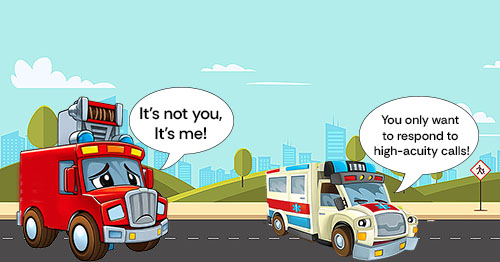
Those are worthwhile discussions. But before communities consider separating fire and EMS, there is one question that often gets overlooked: How would we pay for (or justify) a fire department that only fights fires? For many communities across North America, EMS has become much more than another service the fire department provides. It has become the financial engine that supports the staffing, facilities, apparatus, and infrastructure needed for around-the-clock emergency response.
Removing EMS from the fire service isn’t simply an operational decision. It is fundamentally a financial one.
EMS Has Changed the Economics of the Fire Service
Fifty years ago, many fire departments existed almost exclusively to suppress fires. Today, that’s no longer the case.
A typical career department may see:
70–85 percent EMS calls.
10–20 percent other emergency responses.
Only 3–8 percent actual fire incidents.
The fire department still exists because those few fires require a rapid, highly trained, fully staffed response. But day to day, EMS has become the service that keeps firefighters busy while maintaining readiness for the next major incident.
That reality has changed how communities view—and fund—their fire departments.
Follow The Money
Many combination fire/EMS agencies receive revenue from several sources that simply do not exist for fire suppression.
These may include:
- Ambulance transport billing.
- Advanced Life Support (ALS) intercept fees.
- EMS service contracts.
- Hospital partnerships.
- Medicare reimbursements.
- Medicaid reimbursements.
- Private insurance payments.
Depending on the system, those revenues can represent millions of dollars each year.
That money doesn’t just buy ambulances. It often helps fund firefighter salaries, stations, apparatus replacement, training, technology and equipment. If EMS became a separate organization, much of that revenue would likely move with it.
The fire department would still need to maintain engines, ladder trucks, stations, battalion chiefs, communications systems and personnel—but with fewer funding sources available.
What If Our Tax Base Goes Up in Smoke?
This conversation comes at a bad time, if you haven’t noticed.
Across the United States, a new wave of anti-property tax initiatives is gaining momentum as homeowners push back against rapidly rising property valuations and the corresponding increase in tax bills. Several states are considering constitutional amendments, expanded homestead exemptions, levy limits, or even proposals to eliminate portions of property taxes altogether. While these efforts are politically popular—particularly in states experiencing rapid growth and escalating home values—they also raise difficult questions about how local governments will replace billions of dollars that currently fund essential services such as fire protection, law enforcement, schools, roads, and emergency medical services. Property taxes have long been the financial foundation of local government, and although reform may provide much-needed relief for homeowners, any significant reduction in property tax revenue will require communities to either find new revenue sources or make difficult decisions about the level of public services they can sustain.
- —JV
The Cost Per Fire Would Rise Dramatically
Here’s the challenge many people miss: Removing EMS doesn’t significantly reduce what it takes to respond to a structure fire.
You still need:
- Staffed engine companies.
- Ladder and other support companies.
- Battalion chiefs.
- On-duty staffing 24 hours a day.
- Specialized equipment.
- Training.
- Reserve apparatus.
- Fire stations strategically located throughout the community.
None of those costs disappear simply because firefighters no longer transport patients. Instead, those same fixed costs become spread across far fewer incidents. From a budget perspective, every fire response becomes substantially more expensive because there are fewer calls over which to distribute those costs.
The Tax Conversation Changes
Today, some taxpayers support fire department budgets because they receive a broad range of emergency services. Their local fire department responds to fires, cardiac arrests, vehicle crashes, rescue incidents, hazardous materials events, medical emergencies and public service requests.
If EMS disappeared tomorrow, residents would still expect the same fire protection. Firefighters would still have to be available within minutes. The difference is that local governments might need substantially higher property taxes or fire district assessments simply to maintain the same level of fire protection.
Politically, that’s a difficult conversation. Many taxpayers would understandably ask why they’re paying more while receiving fewer services from the fire department.
Staffing Would Face New Scrutiny
One of the less obvious consequences would involve staffing. Today’s staffing models often rely on continuous EMS demand. Personnel aren’t simply waiting for fires—they’re actively serving the community throughout the day while remaining ready for the next working fire. Without EMS, elected officials may begin asking difficult questions:
“Why do we need four people on every engine?”
“Why do we need another station?”
“Why are battalion chiefs on duty around the clock?”
Those questions can be difficult to answer if annual fire volume becomes the primary measure of workload. The operational need for adequate fire staffing doesn’t change. The political justification becomes more challenging.
My informal polling & surveys suggest the public believes it
will need EMS much more often than a full fire department response. If those daily responses disappeared, the
department would lose much of its public visibility.
Volunteer Departments May Feel the Greatest Impact
Volunteer and combination departments could face even greater challenges. Many volunteer organizations have expanded EMS not only because communities needed the service, but because it helped sustain the organization.
EMS often provides:
- Additional operating revenue.
- Increased member activity.
- Greater recruitment opportunities.
Many departments rely on ambulance billing to offset operating expenses that local tax revenue simply doesn’t cover. Without that income, some agencies could face difficult financial decisions regarding equipment replacement, staffing support and long-term sustainability.
Visibility Matters
There’s another consequence that rarely gets discussed. EMS keeps the fire department visible, promoting and delivering (great) customer service across a wide range of high- and low-acuity emergency medical calls. Those interactions build community trust. Residents see firefighters solving problems every single day—not just during major fires.
When I informally polled groups while giving talks about fire department services, I would ask two questions:
- “How many of you believe you will need the fire department to respond to your house for a fire in the next 10 years?” Every single time, maybe one or two would raise their hand (often no one would).
- “How many of you believe you will need paramedics and an ambulance to respond to your house for a medical emergency in the next 10 years?” Most of the time, at least half the hands in the room would go up.
My informal polling and surveys suggest the public believes it will need EMS much more often than a full fire department response. If those daily responses disappeared, the department would lose much of its public visibility. Over time, that reduced interaction could influence how elected officials and taxpayers perceive the value of maintaining current fire department budgets.
Are There Benefits to Separation?
Absolutely. Successful models exist where independent EMS agencies provide outstanding patient care. Potential advantages include:
- A singular focus on medical quality improvement.
- Specialized EMS leadership.
- Clinical protocols tailored specifically to patient care.
- Career paths designed exclusively for paramedicine.
- Reduced burnout among firefighters who prefer suppression operations.
The question isn’t whether separation can work. Hospital-based EMS systems and several municipal third-service agencies have demonstrated that these models can succeed. The question is whether a community fully understands the financial implications before making that decision.
The Financial Reality
Unlike EMS, fire suppression generates very little direct revenue. Communities generally cannot bill for:
- Structure fires.
- Vehicle fires.
- Fire alarms.
- Fire prevention.
- Public education.
- Most technical rescues.
- Hazard mitigation.
Those services are funded almost entirely through taxes. EMS, however, often benefits from multiple funding streams that help offset operating costs.
Remove EMS from the fire department, and those funding streams frequently disappear as well. Unless local governments replace that lost revenue, departments are generally left with three options:
- Increase taxes
- Reduce staffing
- Reduce service levels
None of those choices are particularly attractive.
Some Politicians Want To Dump EMS, Too
Across the country, some elected officials are increasingly viewing EMS as a budget problem rather than an essential public safety service. When communities face financial pressure, proposals to privatize, outsource or separate EMS from the fire service often emerge as a way to reduce government spending. While every community should regularly evaluate how services are delivered, decisions based primarily on short-term financial savings can overlook the broader value of an integrated fire/EMS system—including faster response times, cross-trained personnel, operational flexibility, disaster readiness and the ability to maintain staffing that benefits both fire suppression and emergency medical care. The discussion should focus on the total impact to public safety, not simply the cost of providing EMS.
The Bottom Line
The debate over separating fire and EMS shouldn’t be framed as simply deciding who responds to medical calls. It’s really a conversation about the fire service’s future business model. Could separate agencies work? Certainly. Some communities already do it successfully. But communities considering that change must recognize that today’s fire departments are funded around a service model that includes far more than fire suppression.
EMS has become intertwined with staffing, budgeting, station locations, apparatus replacement, and the overall sustainability of many organizations. If EMS is removed, something else must replace both the workload and the revenue it brings. Otherwise, communities may discover that maintaining the same level of fire protection becomes significantly more expensive than they ever imagined.
As fire service leaders, we must ensure decision-makers understand the operational and financial consequences before changing a system that has evolved over decades. Whatever model a community chooses, it should serve the public, be supported by sustainable funding, and deliver the resources needed when the next fire, rescue, or medical emergency occurs.

John Vance has spent more than three decades in the fire service and has served as a chief officer since 2002. His career has taken him from Indiana to Minnesota, leading fire departments, developing people and working to make fireground operations safer, more effective and a little less complicated. He retired as a fire chief in 2024 but, like a lot of fire chiefs, apparently wasn’t very good at actually retiring.
John is a longtime Blue Card lead instructor and has spent years teaching, writing and helping fire departments develop more capable and confident incident commanders. He is an accredited chief officer through the Center for Public Safety Excellence and holds a bachelor’s degree in fire service management from Southern Illinois University and a certificate in executive leadership from the University of Notre Dame.
Before the fire service completely took over his life, John spent years in broadcasting—and he never quite got the microphone out of his system. Today, he hosts the B Shifter Podcast, where he talks with fire service leaders, instructors, researchers and practitioners about command, leadership, training and the lessons that can make the fire service better.