



The Fire Command System Offers a Just-Right Fit for Type 4 & 5 Incidents
October 5, 2026The Fire Command System Offers a
Just-Right Fit for Type 4 & 5 Incidents
While NIMS was built for large-scale, multiagency incidents, Fire Command shines where it matters most: on the local fireground, every day.
By Nick Brunacini
B Shifter Buckslip, Oct. 13, 2026
NIMS and Fire Command are not competing incident management systems. They support and complement one another, with NIMS providing the blueprint for managing large, complex, multi-agency incidents and Fire Command providing the operational framework for day-to-day local fire department incidents. Understanding how the two systems differ is essential to using each effectively.
An IMS of the 70s Paved the Way for a 21st Century Command System
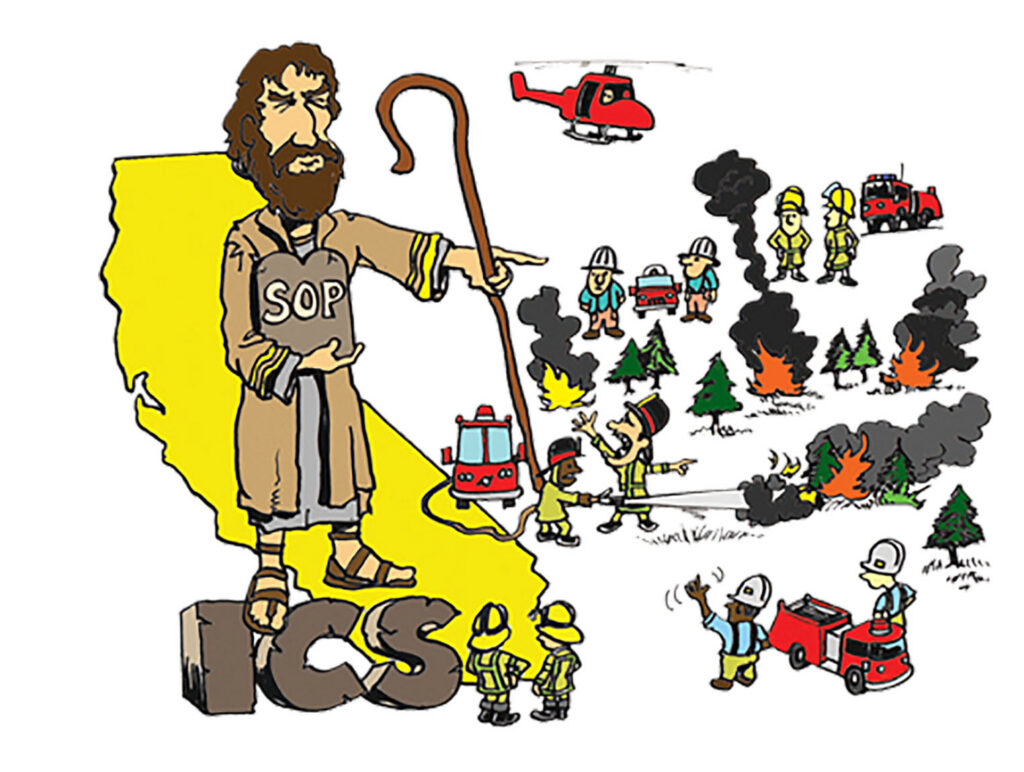
In the early 1970s, the new term wildland-urban interface was introduced in Southern California, ushering in the creation of FIRESCOPE and the National Interagency Incident Management System. FIRESCOPE and NIIMS were established to unify dozens of local emergency response agencies, the state of California and the U.S. government (via the National Wildfire Coordinating Group) at the scene of large wildland fires that burn into civilization. These operations demand an army of resources: up to thousands of firefighters and other emergency responders, aircraft, and large camps to house, feed, shelter and care for those workers. Incidents of this size and scope can last weeks to months and require the combined efforts of all local, state and federal agencies involved.
In the early 2000s, the federal government adopted NIIMS as its only command system. The first change the feds made was to call it the “National Incident Management System,” or NIMS. They did this right after placing a host of government agencies within the newly created “Department of Homeland Security.” FEMA was placed in charge of NIMS and the National Response Plan (NRP), with the general edict that anyone responding to emergency scenes must be NIMS-compliant. (I still have a box full of NIIMS and NIMS completion certificates.) The original intent was for all federal agencies to work together. The mandate that all local firefighters be “NIMS compliant” doesn’t change the fact that NIIMS/NIMS was never intended to manage day-to-day local fire department incident activity. In 29 years of local incident response, I never used my NIMS training.
Those who believe NIMS is perfectly suited to manage Type 4 & 5 incidents often use the term “scalable.” NIMS is scalable in the same way an aircraft carrier is scalable for use as a personal fishing boat.
One Size Does Not Fit All
FEMA’s current incident typing system works very well. Static NIMS incident management teams are maintained to manage Type 1 and 2 incidents, the largest and most complex incidents. These incidents require the coordinated efforts of local, state, and federal resources to bring them under control and begin restoration efforts. States remain in charge of Type 3 incidents. NIMS is specifically designed to manage these types of incidents. Regular, day-to-day local fire department Type 4 and 5 incidents are best managed using the Fire Command system.
The current “one and done” approach to NIMS familiarization and compliance is perfectly suited to introducing the Type 4 and 5 fire service to the unique requirements of managing massive, weeks-long incident operations, even though most of the North American fire service will never respond to incidents of this type. But expecting NIMS training to provide everything the North American fire service needs to manage Type 4 and 5 incidents is shortsighted. NIMS is not designed to address the firefighter safety and survival requirements associated with operating in IDLH hazard zones on 15-minute work cycles.
Those who believe NIMS is perfectly suited to manage Type 4 and 5 incidents often use the term “scalable.” NIMS is scalable in the same way an aircraft carrier is scalable for use as a personal fishing boat. NIMS works best for preplanned events or current large-scale incidents that require at least a few hundred incident workers and responders. For incidents that are currently underway, a NIMS command team requires a minimum of three days to set up. Establishing the infrastructure needed to support logistics for these complex NIMS incidents can take a week.
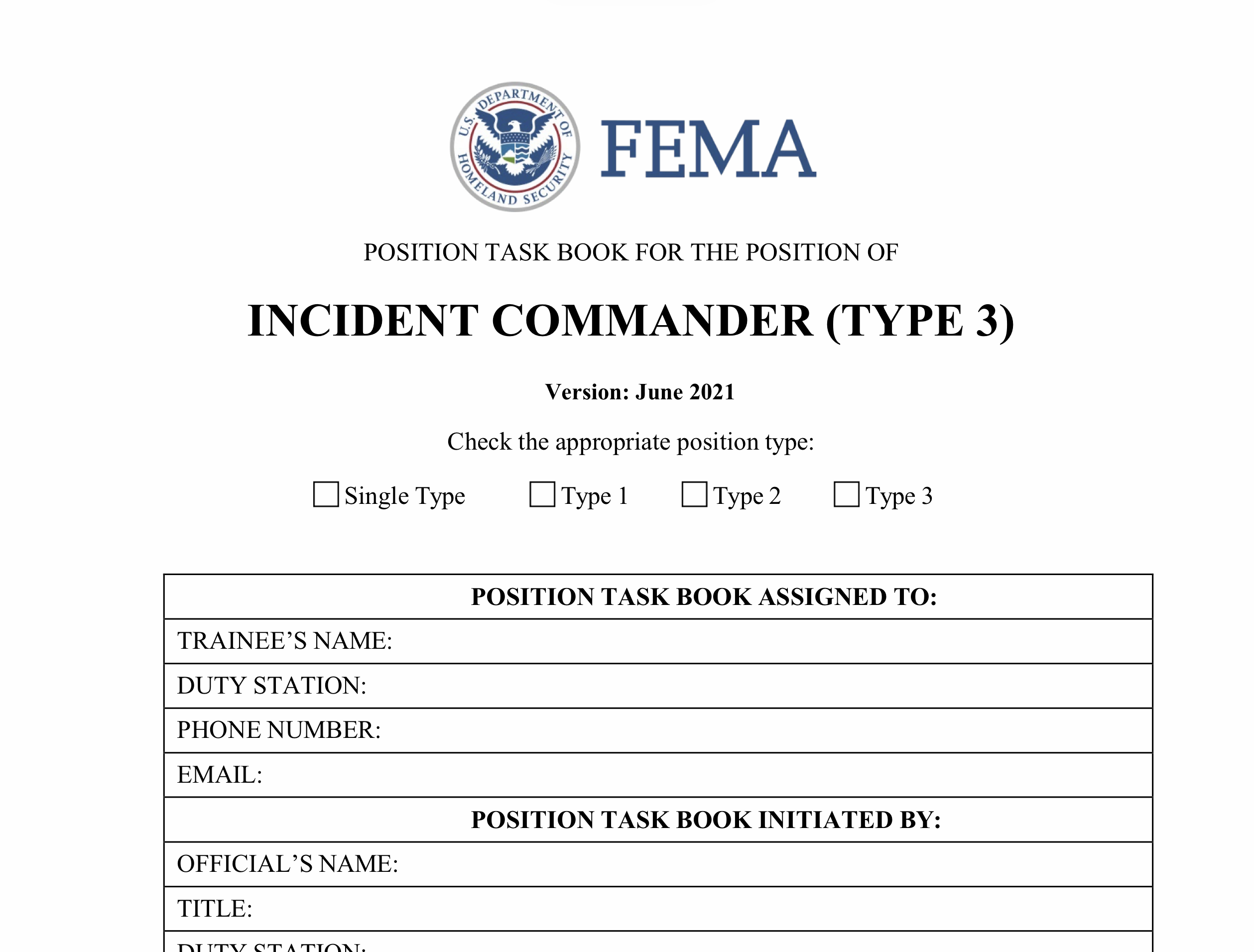
Pictured is an evaluation form from the FEMA Incident Commander Task Book. NIMS was created to manage large incidents and uses incident typing to identify who is responsible for managing an incident. NIMS Type 1 and 2 incidents are the responsibility of the federal government. NIMS Type 3 incidents are the ultimate responsibility of the state where the incident is occurring. What isn’t listed on this NIMS form are Type 4 and 5 incidents, which are the responsibility of the local fire department. This same truth holds for any NIMS training material. Short of a few sentences claiming NIMS to be scalable, very little in NIMS applies to managing local fire department service delivery.
Good luck finding risk-management content in the NIMS system that addresses managing risks from actual Type 4 and 5 incidents. Risk management in the NIMS ecosystem focuses on identifying major pre-response community risks to prevent them and/or mitigate them more effectively if they occur. These risks include severe weather, earthquakes, compromised dams, and public health crises. This is typically the responsibility of the local emergency manager.
Risk management for structural firefighting is the responsibility of officers working on all three organizational levels: strategic, tactical and task. In the Fire Command system, this begins with the IC using the incident strategy as the foundation for managing firefighter safety and survival. The IC then uses critical fireground factors to determine the strategy and tactics needed to accomplish the incident goals (i.e., tactical priorities and objectives). NIMS has no information for managing incident action plans that do not require long planning sessions and written documentation. Because task-level personnel operate in SCBAs, Fire Command is built around 15-minute work cycles. Its accountability, tracking, incident organization, standard company work cycles, and other components are all designed around these operational realities. NIMS was never meant for this type of work. An overwhelming number of NIOSH LODD recommendations are based on the Fire Command system, not NIMS, because NIMS was never intended to manage the risks associated with local Type 4 and 5 incidents.
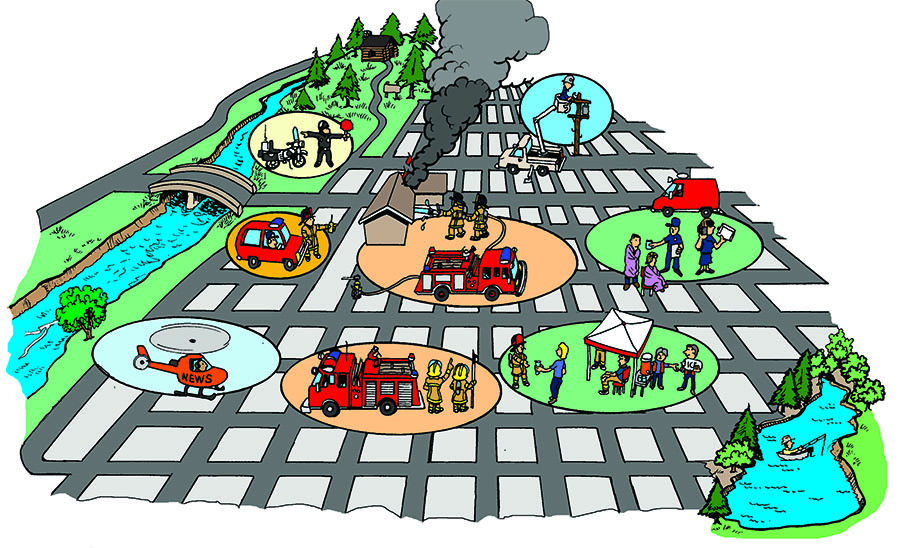
Expecting NIMS training to provide everything the North American fire service needs to manage Type 4 and 5 incidents is shortsighted. NIMS is not designed to address the firefighter safety and survival requirements associated with operating in IDLH hazard zones on 15-minute work cycles.
Fire Command Continues to Evolve
Fire Command is more than 40 years old and has just been updated with a third edition. The NFPA published the first and second editions, which preceded NFPA 1500 and 1700. It’s no surprise that a command system published by the organization that created the defining fire service standards is best suited to managing the incident operations those standards were designed to support. (Remember in “Zoolander” when Will Ferrell’s character, Mugatu, asks, “Am I taking crazy pills?!?!”)
Fire Command is a proven system that has been continuously revised and improved. Its foundation remains the Eight Functions of Command. The third edition adds a safety chapter describing the requirements for operating in IDLH hazard zones and the system’s embedded safety features. It also includes a chapter on preventing and mitigating firefighter mayday emergencies. NIMS does not address or support any of the requirements for managing a local fire department’s day-to-day incident activity, which accounts for more than 99 percent of all fire department response. Additionally, NIMS views accountability differently, has no policies or procedures that address rapid intervention or the management of firefighter maydays, and does not identify or utilize incident strategies (offensive or defensive). Conversely, Fire Command is designed so the IC can immediately control both the position and function of all personnel operating in the hazard zone. NIMS refers to this capability as the “responsibility of division officers.”
Blue Card Delivers Fire Command as a Structured Practice
Fire Command is the basis of the Blue Card Program, the most comprehensive incident command training and certification program for fire departments and members who serve as ICs. Students complete 30 hours of cognitive training through an interactive online platform. They earn certification by successfully performing as both IC 1 and IC 2 in 10 multi-position structure fire simulations during a three-day simulation lab, which is delivered by the department’s operational leadership. Students maintain certification by completing 36 hours of continuing education during their three-year certification window. There are more than 40 two- to three-hour online CE modules, including first responders’ programs for both technical rescue and hazmat.
Blue Card trainers have access to a catalog of 40 multi-position structure fire simulations. Blue Card also offers two-day workshops on strategic decision-making, managing fires in big-box structures, division operations, and preventing and mitigating firefighter mayday emergencies. Additional programs are available for first responders (non-officers), dispatchers and ARFF personnel. Much of this content qualifies for college credit and has historically been supported by FEMA’s Assistance to Firefighters Grants program. This summer, we will begin updating the current Blue Card Program to incorporate the third edition of Fire Command.
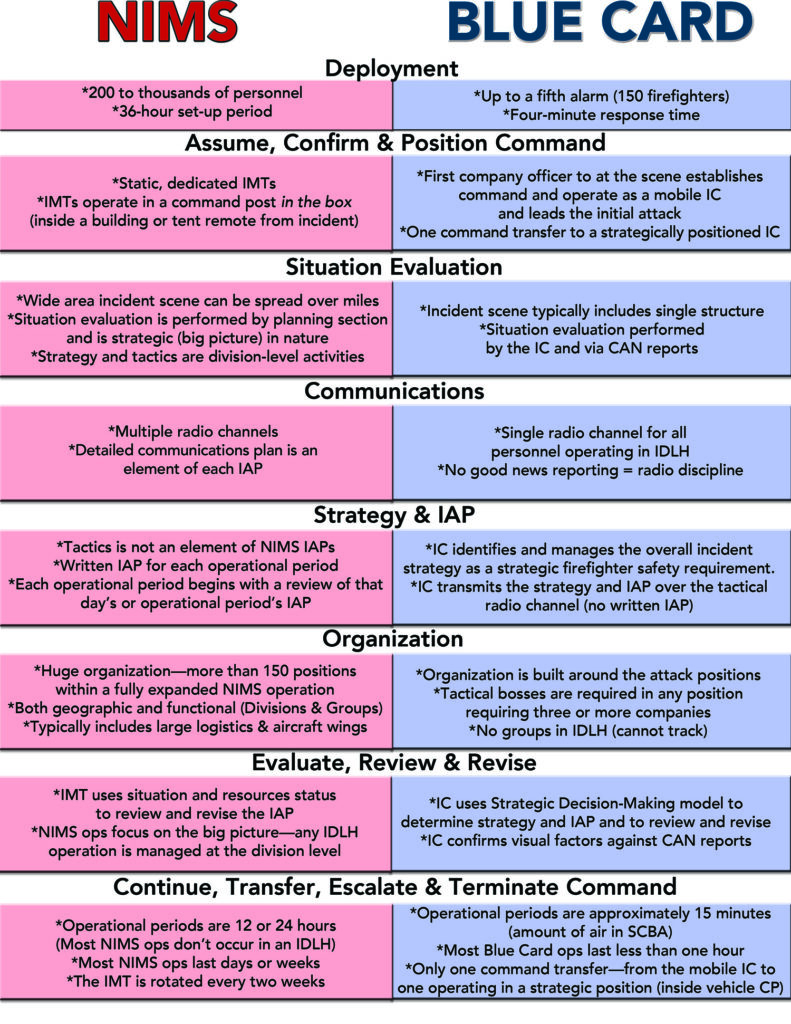
Click the image above to download a PDF comparing key differences between NIMS and Fire Command/Blue Card.
Becoming a certified Blue Card IC requires the student to show proficiency in performing as the IC. NIMS compliance training is much less robust and leads to no noticeable improvement in performance by the student or department. Since 2008, 4,000 fire departments have trained and certified more than 75,000 students as Blue Card ICs. The first federal organization to be fully Blue Card certified was Air Force Space Command. They have spent the last 15 years successfully utilizing both NIMS and Fire Command/Blue Card. They have had several incidents where they utilized Blue Card to manage certain elements within the larger NIMS Type 1 incident op.
Because Fire Command utilizes an organizational structure similar to NIMS, managing a Blue Card operation as part of a NIMS Type 1 event is seamless: The Blue Card elements of the incident report within the NIMS operation at the division or branch level. The Blue Card IC manages their operation while the support officer is available to communicate with their reporting agent (branch or operations).
The fire service does not have to choose between NIMS and Fire Command. They are complementary command systems designed to solve different problems. NIMS provides the structure for incidents that expand across jurisdictions and agencies, while Fire Command provides the operational structure and safety practices needed for the Type 4 and 5 incidents local departments manage every day. The key is not choosing one over the other. It is understanding where each fits and ensuring firefighters are trained to use both.

Nick Brunacini joined the Phoenix Fire Department (PFD) in 1980. He served seven years as a firefighter on different engine companies before being promoted to captain and working nine years on a ladder company. Nick served as a battalion chief for five years before promoting to shift commander in 2001. He then spent the next five years developing and teaching the Blue Card curriculum at the PFD’s Command Training Center. His last assignment with the PFD was South Shift commander. Nick retired from the PFD in 2009 after spending the first 26 years of his fire-department career as a B-shifter and the last three on C Shift. Nick is the author of “B-Shifter—A Firefighter’s Memoir.” He also co-wrote “Command Safety.” Today, he is the publisher of B Shifter and a Blue Card instructor.