


The NIOSH 5—Essential Factors That Still Shape Fireground Safety
September 11, 2026The NIOSH 5—Essential Factors That Still Shape Fireground Safety
Rooted in recurring lessons from firefighter fatality investigations, the NIOSH 5 continue to influence how departments approach command, risk assessment, accountability, communications and SOPs.
By Murrey Loflin
B Shifter Buckslip, Sept. 15, 2025
“Mayday! Mayday! Mayday!” are the most alarming words heard on the fireground. These words signal that something has gone terribly wrong and a firefighter—or multiple firefighters—is in distress and requires immediate assistance. What do you do? How do you manage an event of this magnitude? Why did it happen in the first place?
During the first day of Blue Card’s Mayday Management Workshop, instructors review the NIOSH Fire Fighter Fatality Investigation and Prevention Program (FFFIPP), examine line-of-duty death (LODD) investigation reports involving a mayday, and discuss the NIOSH 5. The intent is to determine what happened to cause the LODD, identify contributing factors and system gaps, and consider how responders can prevent similar incidents in the future. The exercise then segues into a discussion of how to prevent a mayday and how to manage one should it occur.
To understand how the NIOSH 5 came to influence the fire service, it helps first to understand the agency and program whose work brought these recurring factors to light.
Tracing the Roots of the NIOSH 5
In 1970, the Williams-Steiger Act established the Occupational Safety and Health Administration (OSHA) and the National Institute for Occupational Safety and Health (NIOSH). NIOSH researches worker safety and health and helps employers and workers create safer workplaces. It is part of the Centers for Disease Control and Prevention, within the U.S. Department of Health and Human Services. NIOSH has six offices nationwide, including its Washington, D.C., headquarters.
In February 1998, Congress authorized NIOSH to investigate firefighter LODDs with a one-time stipend of $2.5 million. The agency initiated the FFFIPP at that time to conduct independent investigations of firefighter LODDs and serious injuries. Based on these investigations, NIOSH develops recommendations to prevent similar firefighter deaths and injuries. The FFFIPP’s objectives are to:
• Better identify and define the characteristics of firefighter line-of-duty deaths.
• Recommend ways to prevent deaths and injuries.
• Disseminate prevention strategies to the fire service.
As part of the NIOSH Division of Safety Research, the FFFIPP does not enforce compliance with state or federal job safety and health standards, nor does it determine fault or place blame on fire departments or individual firefighters. This process exists to influence fire departments to critically assess and evaluate situations/circumstances like those identified in NIOSH investigations. The intent is for fire departments to implement the recommendations to prevent future firefighter fatalities.
Turning Lessons Into Action
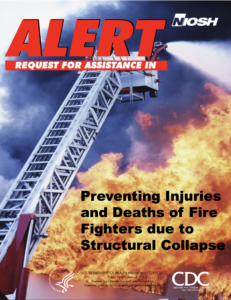
In August 1999, NIOSH FFFIPP investigators published a document titled “NIOSH ALERT: Preventing Injuries and Deaths of Fire Fighters due to Structural Collapse.” Developed by NIOSH FFFIPP investigators and a group of subject-matter experts, the Alert was the first document produced by the program other than firefighter LODD investigation reports.
In the Alert, NIOSH encouraged fire departments to implement occupational safety programs and SOPs/SOGs and identified 10 essential steps to help prevent firefighter injuries and deaths during structural firefighting:
- Ensure that the incident commander (IC) conducts an initial size-up and risk assessment of the incident scene before beginning interior firefighting operations.
- Ensure that the IC maintains accountability for all personnel at the fire scene by both location and function.
- Establish rapid intervention crews or teams (RICs/RITs) and position them to respond immediately to emergencies.
- Ensure that at least four firefighters are on scene before beginning interior firefighting at a structural fire: two firefighters inside the structure and two outside.
- Equip firefighters entering hazardous areas, such as burning or potentially unsafe structures, with two-way communications with the incident commander.
- Ensure that standard operating procedures and equipment adequately support radio traffic at multiple-responder fire scenes.
- Provide all firefighters with personal alert safety system (PASS) devices and ensure they wear and activate them during firefighting, rescue, or other hazardous duties.
- Conduct pre-fire planning and inspections that address all building materials and structural components.
- Immediately transmit an audible tone or alert when conditions become unsafe for firefighters.
- Establish a collapse zone around buildings with parapet walls.
The NIOSH 5 Emerges
Shortly after the Alert was published, what became known as the NIOSH 5 began appearing in numerous fire service publications. This list details the top five operational factors contributing to fireground LODDs. It is unknown who within the fire service first initiated or developed the NIOSH 5, but it was not initiated or developed by the NIOSH FFFIPP. Regardless of who first distilled these recurring factors into a list of five, they closely reflect the operational and command deficiencies repeatedly identified in firefighter fatality investigations and have become a widely recognized framework for examining fireground risk. The NIOSH 5 are:
1. Improper/Inadequate Risk Assessment (Size-Up)
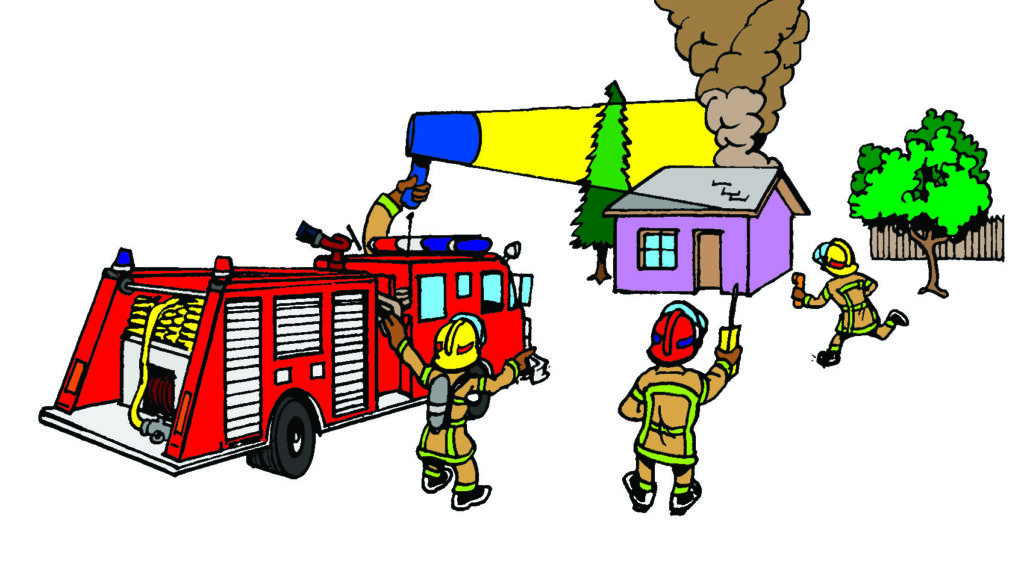
Incident scene size-up gives the IC and all members a snapshot of the initial conditions encountered. Completing a 360 is a critical part of the size-up process because the information gathered helps inform risk assessment. When a complete 360 is achieved, it provides the IC and all personnel with information about the building’s layout and construction, access and egress points, the fire’s location and direction of spread, and any potential obstacles or hazards. Size-up is a continuous process.
If the IC cannot complete a 360 because of the building’s size or obstructions, the IC should assign an individual or company to continue the process until all sides of the incident have been viewed. Additionally, every attempt should be made to obtain a basement report. This information should be communicated to the fire alarm office/dispatcher.
Completing a 360 is a critical part of the size-up process because the information gathered helps inform risk assessment.
2. Lack of or Improper Use of the Incident Command System
Each fire department should adopt an incident management system for all emergency incidents (for example, Fire Command and the Eight Functions of Command). This system must defined in writing and must include SOPs/SOGs covering its implementation.
The incident management system covers more than fireground operations. It must also incorporate command and firefighter safety, including risk assessment and continuous evaluation; strategy and incident action planning; critical fireground factors; a risk management plan; a strategic decision-making model; incident priorities; personnel accountability; and communications (e.g., the initial radio report, critical incident benchmarks and forecasting).
3. Lack of Personnel Accountability
A personnel accountability system readily identifies both the location and function of all members operating at an incident scene and shares the same principles of an incident management system—company and command unity. It is possible to fulfill unity initially and maintain it throughout the incident by documenting the situation status and resource status on a tactical worksheet or a resource status/accountability board.
4. Inadequate or Ineffective Communications
Effective fireground radio communication is a valuable tool to support proper command and control of an incident and firefighter safety and health. The radio system must be dependable, consistent and functional to ensure that effective communications are maintained, especially during emergency incidents. Fire departments should have a communications SOP for fireground operations and must ensure that the department’s communications division, communication center and dispatch center are part of this process. Another important aspect of this process is an effective education and training program for all department members.
5. Lack of Established SOPs/SOGs or Not Following Them
A department’s SOPs/SOGs detail in writing the actions and steps that all fire department members must follow. They define how the fire department expects members to act in specified situations.
When those procedures do not exist, are inadequate or are not followed, personnel may be forced to make critical decisions without a common operating framework. The result can be inconsistent actions, communication and coordination, increasing the likelihood that other contributing factors associated with firefighter injuries and LODDs will develop.
Training to Prevent the NIOSH 5
Think back to any chaotic, disorganized incident you’ve responded to. Chances are, one or more of the NIOSH 5 were present. The question then becomes, “How does a fire department fix these issues?”
In the book “Command Safety,” Alan and Nick Brunacini emphasize the importance of clearly defined safety responsibilities at each level of the organization: strategic, tactical and task. Each level has distinct safety functions, and one cannot perform the responsibilities of another. When any level is missing or not properly utilized, conditions can develop that allow one or more of the NIOSH 5 to emerge.
Fireground LODDs have declined over time, according to statistics from the United States Fire Administration and the National Fire Protection Association, but continued improvement depends on preparation. Training is critical to ensuring that incident commanders have the knowledge, skills, abilities and competencies to effectively manage the fireground, recognize the conditions represented by the NIOSH 5 and address them before they contribute to a mayday or firefighter fatality.
Author’s Note: Blue Card’s Mayday Management Workshop Is Time Well Spent
A mayday presents one of the most challenging events an incident commander can face. It demands rapid decision-making, effective communication and disciplined command. Just as important is understanding the factors that led to the emergency and identifying strategies to prevent similar incidents. Blue Card’s two-day Mayday Management workshop examines these issues in depth. The program provides task-, tactical- and strategic-level approaches to managing firefighter maydays and reinforces those concepts through realistic simulation-based training.
Please attend Blue Card’s Mayday Management Workshop. It is time well spent.
Murrey E. Loflin started his fire service career with the Beckley (W. Va.) Fire Department as a firefighter/EMT in June 1979. He was hired by the Virginia Beach (Va.) Fire Department in February 1983, as a firefighter/EMT. He held the ranks of captain and battalion chief. He was appointed the department’s first safety officer in 1986. He retired from the Virginia Beach Fire Department in August 2006. That September, Murrey was hired by West Virginia University Extension Services in Morgantown, W. Va., where he served as the director of Fire Service Extension and the director of the West Virginia State Fire Academy in Jackson’s Mill. In December 2010, Murrey accepted a position as investigator with the NIOSH Fire Fighter Fatality Investigation and Prevention Program located in Morgantown, W.Va. Murrey retired from the federal government in May 2025.