



AUTHOR DRAFT. Do not publish. With Blue Card, Every Crew’s a RIC #2
June 21, 2026With Blue Card, Every Crew’s a RIC
When rapid intervention is a capability of the entire response, there’s no need for the “best” of us to rescue the rest of us.
By Nick Brunacini
B Shifter Buckslip, June 23, 2026
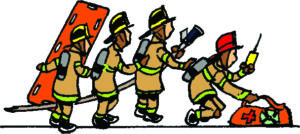
Around 40 years ago, the fire service developed the concept of rapid intervention as a response to firefighter mayday emergencies. Traditional rapid intervention placed a crew on standby in front of the structure. Their only job was to intervene if a firefighter required rescue. Rapid intervention crews (RICs) were equipped with specialized gear in a rescue bag, including air transfill equipment, flashlights, cutters, lifelines and hand tools. In the early 2000s, I wrote a monthly article for a fire service publication that allowed me a bit of latitude. The most reader responses I ever received were to an RIC article that described a fictional firefighter rescue device: a small yet powerful hand grenade used to breach walls in the event of a mayday. Dozens of inquiries poured in, asking where departments could purchase these life-saving gadgets. Some firefighters (B-shifters) wanted to know whether these grenades could be used to vent roofs, extinguish the fire via explosion, or combined to blow larger holes.
A recurring RIC fantasy is that firefighters serving on RICs should be the
most skilled & proficient among us—true heroes protecting lesser heroes.
Despite giving us a false sense of security, having a single company standing by did not deliver a solution to firefighter mayday emergencies. It proved to be too little, too late. In many systems, RIC simply checks a box, allowing the remainder of the response to operate without constraint. Delegating firefighter safety and survival to safety officers and RICs in an otherwise unmanaged incident operation is every bit as effective as hiring professional athletes to exercise for you or having really smart scientists go to school for you.
A recurring RIC fantasy is that firefighters serving on RICs should be the most skilled and proficient among us—true heroes protecting lesser heroes. At this year’s big fire show, I was part of a conversation where RIC members were referred to as the “Navy SEALs” of firefighters. The individual making this statement went on to say the biggest problem with Blue Card is that it diminishes the role of RICs. I quickly lost interest in this 25-year-old firefighter with five years of experience scolding a group of us twice his age with his tactical bullshit. I shifted my focus from Johnny RIC Ringo to the robots in the neighboring booth. One of the dog-shaped robots had a nozzle mounted to its back and ran sideways before heading up the stairs. The human-shaped robot danced, tumbled and spun in circles on one foot. It didn’t remind me of RICs or Navy SEALS so much as the Terminator. Rest assured, its next evolution will be the cross of a human and a full suite of hydraulic rescue tools. Put a trailer-hitch nut sack on the thing, and it could deliver the opening address for next year’s conference.
The idea that we would hold a group of more capable firefighters
in reserve in case something happens to a “regular” firefighter is simply ignorant.
What makes fire department customer service effective is the speed of our response. Fire departments are staffed by enough firefighters to produce a five-minute response time throughout the community—this makes us who we are. No other group on the planet makes house calls in five minutes. The fire service uses standards to ensure that each firefighter has the required combination of training and physical capability, along with the tools, equipment and leadership to deliver emergency service. The idea that we would hold a group of more capable firefighters in reserve in case something happens to a “regular” firefighter is simply ignorant. Again, this is why the fire service uses standards to ensure firefighters can perform the work.
Phoenix Firefighter Bret Tarver had Navy SEAL-level physical capabilities. Smaller, weaker firefighters risked their lives to extricate his dead body from a defensive fire. This brings us to another false belief that rapid intervention is the ultimate solution for the hazards firefighters face when operating inside burning buildings. Maydays can take three to four crews more than 20 minutes to resolve. The cost of acquiring this real-world experience is oftentimes the life of a firefighter. One of the major benefits of utilizing an effective hazard-zone management system is that it prevents firefighter mayday emergencies from occurring in the first place. Besides preventing maydays, an effective management system allows the IC to take immediate actions to resolve a mayday should one occur.
When we manage rapid intervention as a capability of the entire response, rather than as an assignment to a single task-level unit, every crew operating at the incident scene becomes a potential RIC. This is called the Help Order, which designates the companies closest to the mayday firefighter as the best option to provide assistance. Utilizing a system that establishes command at the beginning of the incident, allowing the IC to assign each unit to the incident action plan with an order that includes a task, location and objective, ensures the IC’s control over the position and function of all personnel. This is the Help Order’s true foundation. A system in which the IC controls the positions and functions of all operating personnel will always outperform a legion of traditional safety officers and RICs. Another inescapable fact is that dogs will always be better companions than robots.

Nick Brunacini joined the Phoenix Fire Department (PFD) in 1980. He served seven years as a firefighter on different engine companies before being promoted to captain and working nine years on a ladder company. Nick served as a battalion chief for five years before promoting to shift commander in 2001. He then spent the next five years developing and teaching the Blue Card curriculum at the PFD’s Command Training Center. His last assignment with the PFD was South Shift commander. Nick retired from the PFD in 2009 after spending the first 26 years of his fire-department career as a B-shifter and the last three on C Shift. Nick is the author of “B-Shifter—A Firefighter’s Memoir.” He also co-wrote “Command Safety.” Today, he is the publisher of B Shifter and a Blue Card instructor.


