




AUTHOR REVIEW DRAFT. DO NOT POST. Think You’re a Strong Leader? Your Reactions Might Prove Otherwise
January 24, 2026Think You’re a Strong Leader? Your Reactions Might Prove Otherwise
By Terry Garrison
B Shifter Buckslip, Jan. 27, 2025
I heard a quote the other day that I have adjusted to fit our overall leadership discussion: “It is easy to act like a leader and much more difficult to react like one.” Although this might not be true for all fire service leaders, there are enough supervisors, chief officers and fire chiefs that resemble this remark for us to consider exactly what it means and how it plays out in our everyday leadership scenarios.
Big Hat, No Cattle?
We all know bosses who only act like a leader, but when it comes down to it, they don’t come through for their firefighters or the customer. They wear the correct uniform, they attend all the right parties, they hang around the right people, they say the right things—they even look like a leader, right out of central casting. But these are just surface traits. When you dig down, you find they are nothing more than a shiny penny. I have heard these leaders referred to as “good dudes” and “political appointees.” My all-time favorite, which I heard in Texas, was “big hat, no cattle.” No matter what you call them, they all have one thing in common: They are dropping the ball on fire-service leadership. Now, I could go on to describe the negative behaviors of these leaders (and I nearly did), but I’d rather focus on how we can improve our reactions in both tough and everyday situations. After all, our reactions say just as much about our character as our actions. If we can learn to act like leaders, it would seem that we could also learn to react like leaders.
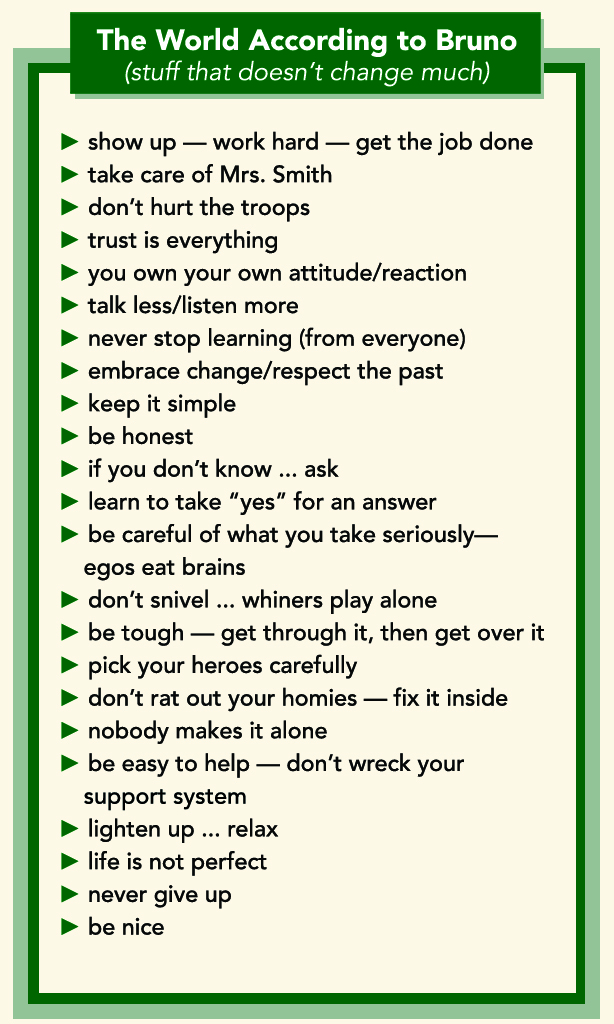
A good place to start is with Alan V. Brunacini’s list of boss behaviors titled “The World According to Bruno,” which I found on a card while going through his vast collection of leadership notes.
The list includes 23 items, so I won’t elaborate on all of them, but the card is pictured at right. Below, I discuss nine of the items that refer to how leaders can react in positive ways.
Click the image, right, to access a printable PDF of the “World According to Bruno” checklist.
1. You Own Your Attitudes & Reactions (Don’t Make Excuses)
Nothing and no one else is responsible for our behavior. In fact, our behavior is the one thing we can always control. Blaming, deflecting and making excuses for bad behavior is weak. There were times throughout my career when I reacted poorly to a situation and blamed it on circumstances. The gifts of experience and hindsight have shown me how wrong I was. Blaming our reactions on something (or someone) else never felt right. Looking back, it seems somewhat childish.)
2. Trust Is Everything (How You React to Their Needs Matters)
We may want to read that again: Trust is everything. It doesn’t only matter sometimes or in some places or with some people. Trust is everything, always. Once a leader loses trust, they effectively lose their ability to influence others, which, along with being supportive, is the primary goal of being a leader. Our leadership positions are given to us by the authority having jurisdiction, but we earn our leadership influence every day from the people we support because of the trust they have in us.
Have you ever worked for someone you didn’t trust? It’s a terrible feeling. I actually worked for a city I didn’t trust. They talked as if they supported firefighters, but they stalled on replacing old, outdated fire stations whose living spaces were commonly filled with fire engine exhaust fumes. They also fought against covering firefighter cancer claims, even though those claims are clearly line-of-duty in nature. Once again, they said all the right things, but when faced with the real costs of improving firefighters’ lives, they balked. Their reaction was not supportive.
3. Talk Less & Listen More (Resist the Urge to Judge, Fix or Rebut)
Listening before passing judgment is difficult for many of us, but it’s one of the best ways to keep our reactivity in check. Sometimes, we quit listening because we are too busy thinking about what we are going to say next to rebut, condemn or “fix” the other person. Trust me, there will always be time for those when necessary. But let’s listen carefully before we do. We might hear information that will help us as we move forward. On the fireground, we must make decisions quickly, with little discretionary time. But that rule doesn’t apply in everyday situations. Remember: Anything you say cannot be unsaid.
4. Never Stop Learning (You Make Better Decisions When You Know More)
Every person and every new situation is a learning opportunity if we choose to see them that way. One good use of discretionary time is gathering as much information and input as necessary before we react. Unfortunately, one of the lessons I learned as a new chief was that almost everyone has an agenda, usually one that benefits them in some way. By getting all the facts and listening to every side of the story, I made better decisions. I can’t help but think that hearing all sides of a situation is similar to doing a 360 on the fireground. A complete size-up is just as important when working through organizational issues.
5. Be Honest (Especially When It’s Difficult)
Being honest is one of the best ways to build trust. This is especially important when giving feedback. A common reaction is to sugarcoat or attempt to soften the blow, but this can backfire. Respectfully telling someone the truth about what they did and what they need to do in the future goes a long way in helping them improve. I have had to terminate firefighters, and it is extremely difficult. Losing their job not only affects them, but their entire family, who had nothing to do with the fact that they were terminated. But I have always been honest with them about their behavior and their future. I was not mean or disrespectful, but I was definitely forthright. (If you think about it, one of the most untruthful things a leader can do is to accept unsatisfactory performance.)
6. Don’t Rat Out Your Homies (Pause Before You Panic)
Please don’t think I’m encouraging cover-ups; negative issues always come to light. What Bruno meant was that we should address as many problems as possible at our level, as leaders within the organization. For example, supervisors should manage issues that fall within their area of responsibility. I once had a fire captain complain to me about the way his crew dressed. Chiefs set policy, but supervisors are responsible for enforcing it. Not everything is a big deal.
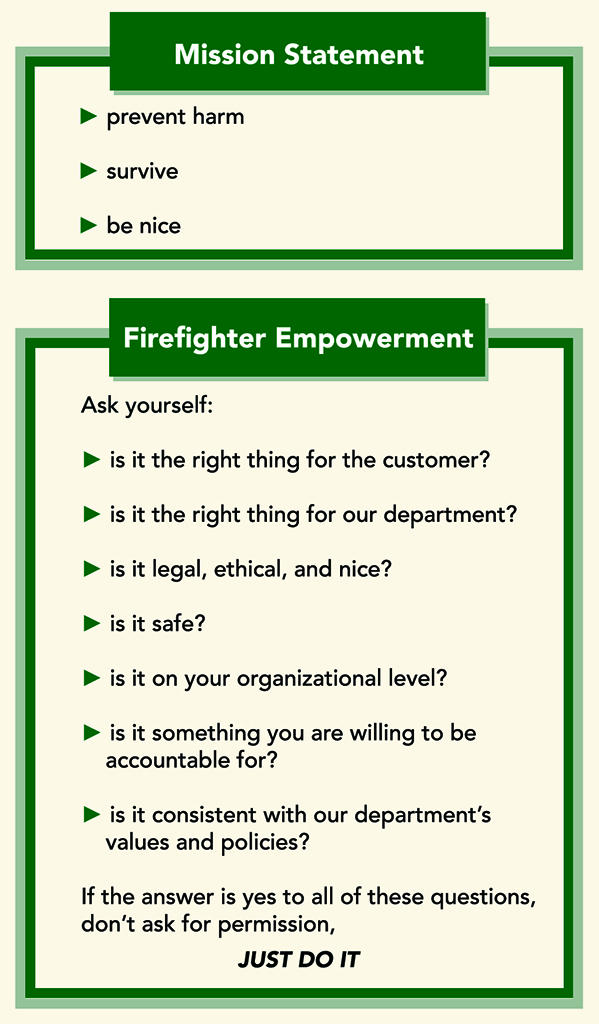
Think back to the empowerment card we shared in a previous issue (see right). If your first reaction is to run something up the ladder, pause for a moment. Use those questions to help determine whether the situation can be resolved at your level.
Click the image, left, to access a printable PDF of Bruno’s “Firefighter Empowerment” checklist.
7. Lighten up…Relax (Most Mistakes Are One-Offs)
Most firefighters who get into trouble are first-time offenders. Most likely, you will not see them in trouble again. Resist the urge to bring down the hammer. Provide them with clear expectations on how to recover, and then allow them to do so. Basically, don’t be an asshole!
8. Life Is Not Perfect (Learn to Face Trouble with Fortitude)
Of course, life isn’t perfect. If it were, I could eat dairy, and the Bears would win the Super Bowl (and I would be at the game, eating nachos.) Years ago, I was complaining to Bruno about a situation I was facing. He told me, “It may not be your fault, but it’s your problem.” And here’s the truth: A big part of being a leader is facing problems. It’s why we get the big bucks. Leadership is never stagnant. We are either moving forward or backward, and the way we react to challenges determines which direction we are going. We cannot avoid problems, hunker down or wish them away. But we can certainly make them worse based on how we react. We must deal with obstacles head-on. I don’t think I am as optimistic as some who say that every problem presents an opportunity—unless we are referring to the opportunity to learn a little bit about ourselves.
9. Be Nice (NICE Can Solve A Lot of Problems)
Characteristics of being nice include treating everyone with respect, kindness, patience, and consideration—even when they mess up. Bruno would say especially when they mess up, because that is when they need it the most. He also used to say, “Never yell down.” Workers will never forget how you treat them—most of all when they’ve made a mistake. If you are mean to them, they will remember what you did, not necessarily what they did. Leaders who can adjust their behavior and react with kindness during the most stressful times help workers improve.
Perhaps the most critical skill for effective leaders is the ability to properly interact with our bosses, peers, workers and customers. Understanding and applying Bruno’s short list above can help us react more appropriately, which is why he carried a card in his pocket at all times. Even he needed a constant reminder that the way we react to others has a long-lasting effect on them and us.
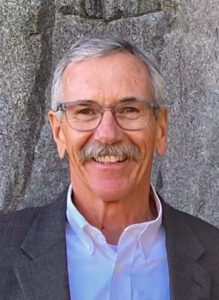
In 2007, Terry Garrison retired from the Phoenix Fire Department after serving more than 30 years. Working for Alan Brunacini and reaching the rank of assistant chief of operations helped shape Terry’s consistent values: firefighter safety and customer service. After a quick retirement, Terry served as the fire chief of the Oceanside (Calif.) Fire Department for almost three years. He then served as the chief of the Houston Fire Department for more than five years. Terry eventually moved back to where he was raised and served as the fire chief for the Glendale (Ariz.) Fire Department for more than six years before officially retiring from government service. Including his two years in the U.S. Army, Terry has worked for the government and worn a nametag and a helmet for over 47 years. (Thank goodness for helmets.) In addition, he has traveled throughout the world teaching Fire Command, utilizing his master’s degree in education. Today, Terry and his wife, Annette, live in Phoenix. He will continue to stay connected to the fire service by working with B Shifter.