



The Best Life Safety Tactic Isn’t Search
The Best Life Safety Tactic
Isn't Search

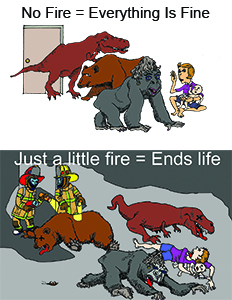
Search, ventilation & rescue all matter, but none delivers a greater life safety benefit than rapid fire control.

By Nick Brunacini
B Shifter Buckslip, June 30, 2026

No single action—or even the collective effects of all the actions we take at the scene of burning structures—positively affects life safety as much as fire control. This truth applies to victims currently located inside the burning building and those who are inside any exposures. The life safety impact of fire control increases as buildings grow in size and complexity. That’s one reason structures with the greatest life safety risks—including public assembly, hospitals and high-density multi-family residential—have built-in fire suppression systems. 

Fire and its associated products of combustion are killers; they are why we call ourselves the “fire department.” Every western that includes a posse pursuing bad guys has a shootout scene where the bad guys hide inside a cabin and exchange gunfire with the good guys (usually positioned among the rocks). Once the good guys determine their gunfire is ineffective, they switch to Plan B, which usually involves covering the cabin chimney to stop the flow of smoke. Justice is delivered a few minutes later when the smoke drives the bad guys from the cabin, and the good guys shoot them like fish in a barrel. Frontier justice via pyrolysis!

Bad Things Come to Those Who Wait

The most efficient, effective structural firefighting incident operations begin with fire control. Eliminating the fire is our offensive approach to controlling the fire, and confining it to the structure of origin keeps the entire community safe. Modern structural firefighting research demonstrates that the quicker we initiate water application, the faster we eliminate the fire’s ability to destroy life and property—especially the life and property inside the burning structure.

A burn clinic doctor once told me that victims located closest to the fire have the poorest outcomes. He said those rendered unconscious by the products of combustion typically end up dying. Prioritizing fire control quickly places firefighters in these areas—the ones most threatened by fire. They search the corridor from the warm zone, where they initiate the fire attack, moving toward the seat of the fire. We control the fire for life—a term I use intentionally to replace the inaccurate, outdated concept of “ventilate for life.”

Early fire control lowers risks for firefighters & victims, minimizes property damage, enables faster search & rescue & reduces both the duration & risk of the incident operation. 

Allowing a fire to burn unchecked in favor of conducting a search or any other activity heightens the risks for the firefighters performing those tasks, the victims inside the structure, and all the people and property in the exposures. In fact, offensive structural firefighting operations that do not begin with fire control have worse life safety outcomes. Search crews must operate under the protection of charged attack lines, not pressurized 2.5-gallon extinguishers. In contrast, early fire control lowers risks for firefighters and victims, minimizes property damage, enables faster search and rescue, and reduces both the duration and risk of the incident operation. Once firefighters have sufficiently engaged the fire by flowing water onto it, additional crews can search other areas of the structure, ventilate the fire area, or perform any tasks required at that point in the operation. For larger, more complex structures, controlling the fire at the very beginning of the incident may be the only task that allows us to search the remainder of the structure.

Exterior Attack Improves Interior Operations

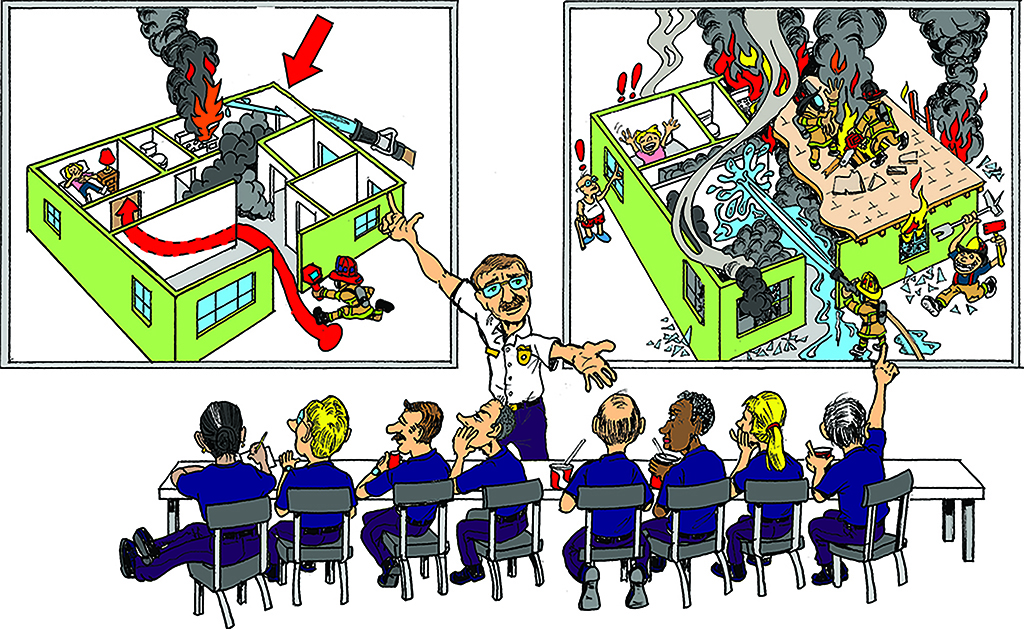
The most effective fire response begins by reducing incident hazards and their corresponding risks as the incident unfolds. Effective task-level action makes the incident safer over time. Initiating offensive fire attacks from the exterior does just that by instantly improving conditions inside. Exterior water application also positions firefighters to protect the exit corridors used to enter and exit the structure. As the fire attack continues, crews are in the best position to search areas adjacent to the main fire area. The effect of these actions is what allows the IC to assign later-arriving companies to begin searching any other areas requiring a search. Successfully achieving fire control removes the major incident hazard, lessening urgency and providing the IC with discretionary time to complete the remainder of the incident operation.

“It’s not accurate to say ‘something went wrong,’ when what happened involved a basically unsafe, dumb or dysfunctional act that had been performed & practiced on the past one hundred (or one thousand) incidents.”   —Alan V. Brunacini

We achieve the best outcomes when we manage our response effectively. The incident action plan is designed to align the best actions with the current incident conditions; it is the required front end for achieving superior incident outcomes. Uncoordinated incident operations that allow search and ventilation before fire control make for much more exciting incident operations, with less desirable outcomes. When this unmanaged approach bites us in the ass, we write it off as “unexpected,” “unforeseen,” or “unpredictable.” Incident commanders who treat risk management as a continuous part of structural firefighting operations often refer to these situations as “defensive fire conditions.”

Author picture

Nick Brunacini joined the Phoenix Fire Department (PFD) in 1980. He served seven years as a firefighter on different engine companies before being promoted to captain and working nine years on a ladder company. Nick served as a battalion chief for five years before promoting to shift commander in 2001. He then spent the next five years developing and teaching the Blue Card curriculum at the PFD’s Command Training Center. His last assignment with the PFD was South Shift commander. Nick retired from the PFD in 2009 after spending the first 26 years of his fire-department career as a B-shifter and the last three on C Shift. Nick is the author of “B-Shifter—A Firefighter’s Memoir.” He also co-wrote “Command Safety.” Today, he is the publisher of B Shifter and a Blue Card instructor.