





Experience Isn’t Enough: Learn how tactical decision games & 10-Minute Training prepare you for real-world decisions
March 6, 2026Experience Isn’t Enough
Learn how tactical decision games & 10-Minute Training prepare you for real-world decisions.
By Ed Hartin
B Shifter Buckslip, March 10, 2026
In the fire service, experience equals credibility. Often, we assume experience develops naturally with years of service. But simply showing up is not enough; we earn experience through the work we do and the decisions we make.
Watching Is Not Doing
Many firefighters and officers serve for years without making certain kinds of decisions. Although responding to fires as a firefighter or engineer builds essential operational skills, it does not necessarily develop command competence. Observing company and chief officers go through the decision-making process offers passive exposure, but those watching do not have to make—or own—those types of decisions.
How Much Experience Do You Really Have?
Training is important, but most firefighters and officers value experience even more. How much experience do you really have?
I recently spoke with a company officer in a busy mid-sized fire department who was working at a low-call-volume station on the city’s outskirts. He observed that although he had more than two decades of fire service experience and had been a company officer for more than 10 years, he had limited experience serving as the initial incident commander (IC). He spent much of his time as an officer at the same station as a battalion chief and seldom had the opportunity to arrive first on scene. Arriving first, taking command and making early tactical decisions forces one to engage in the kind of thinking that builds command competence. His story highlights a reality rarely acknowledged: Not all experience contributes equally to expertise.
Observation helps you understand the terminology, priorities and flow of command. Some ICs provide a good example, while others serve as a cautionary tale. Witnessing others at work can be valuable. However, observation alone does not build command competence. Watching someone else does not require you to recognize critical cues, commit to a course of action or live with the consequences of your decisions. Until you make decisions under time pressure, with incomplete or ambiguous information, and communicate those decisions clearly, you have not engaged in one of the most important elements of command.
The Hidden Gap in Fire Service Training
 Fire service training often focuses on the task level, developing individual and company skills in basic fireground tasks like stretching hose, forcing entry, throwing ladders, conducting search and operating fire apparatus. A high level of proficiency in these basic tasks is essential on the fireground. But something is missing. The fireground is not the drill ground, which is predictable. Emergency incidents are not set-piece training activities that require the same actions every time. Emergencies present a highly variable context. Most fire training does not develop the ability to make high-stakes decisions under limited or ambiguous information and to communicate those decisions clearly and concisely.
10-Minute Training mirrors the cognitive requirements of decision-
making during emergency incident operations. Its benefits are not
limited to a single rank or role.
Developing Experience & Expertise
Experience means you’ve been there and learned something, but it doesn’t always equate to superior performance or expertise. Proficiency requires deliberate practice and deliberate performance. While both methods aim to develop skills and improve performance, they differ in setting and structure.
Deliberate practice is an approach proposed by Anders Ericsson1 and others to develop expertise, particularly in domains like athletics. It incorporates activities designed to improve domain-specific skills. For example, athletes practice outside of competition, repeatedly working on skills with feedback from a coach to improve performance. Training probationary firefighters emphasizes proficiency in basic skills. However, once participants meet the minimum standard, this attention to continuous improvement often fades.
Deliberate performance extends the concept of deliberate practice to real-world work. It’s an ongoing effort to increase domain expertise while engaged in routine activities. Deliberate performance focuses on building tacit knowledge and intuitive decision-making, which many people assume comes only with extensive experience. Receiving timely on-the-job feedback is often difficult. This may require the performer to provide their own feedback.
Tactical Decision Games Offer Deliberate Practice
Tactical decision games (TDGs) provide a way to practice critical decisions before you must make them on the fireground. As a starting point, TDGs do not train for rote performance or tactical perfection. They do train ICs to recognize critical cues and patterns, anticipate changing conditions, make decisions under pressure, and communicate those decisions clearly as task or tactical orders.
TDGs effectively integrate practice and performance. By drawing on the concept of deliberate practice, they isolate specific technical skills, such as situational awareness and communication, allowing focused development. Structured repetition with varied scenarios forces ICs to apply decision-making frameworks repeatedly, building their cognitive skills.
Using targeted questions during debriefing pushes participants beyond superficial answers and encourages critical thinking. But TDGs go beyond deliberate practice, integrating real-world context with the need for rapid decision-making under stress. Debriefing links concrete experiences and decision-making to a deeper understanding of the why behind emergency incident operations.
By repeatedly engaging with these simulated challenges and receiving feedback on their performance, participants develop the flexibility needed to quickly recognize patterns and make decisions under stress.
Fireground Decision-Making Is Different
When facing nonemergent decisions, such as what type of car to purchase, decision-makers generally weigh multiple options to make the best choice. Fireground decision-making is dramatically different.
Beginning at dispatch, fire officers identify a frame of reference that guides their understanding of the situation and the problems it presents. Fire officers frequently recognize critical cues and identify an appropriate course of action without evaluating multiple options. If they question their choice, they evaluate alternatives one at a time until finding an effective solution. When cues contradict their expectations, fire officers work to clarify the situation, allowing them to identify an appropriate response.
Making high-stakes decisions in uncertain, dynamic environments under time stress is referred to as naturalistic decision-making. Gary Klein and others developed the concept of the Recognition-Primed Decision Model2 by studying how fire officers made decisions on the fireground. They learned that fire officers relied on their expertise to make effective decisions in highly challenging environments.
While interesting, learning about naturalistic decision-making theory will not make you a more effective incident commander, but it explains why developing expertise in decision-making requires both deliberate practice and performance.
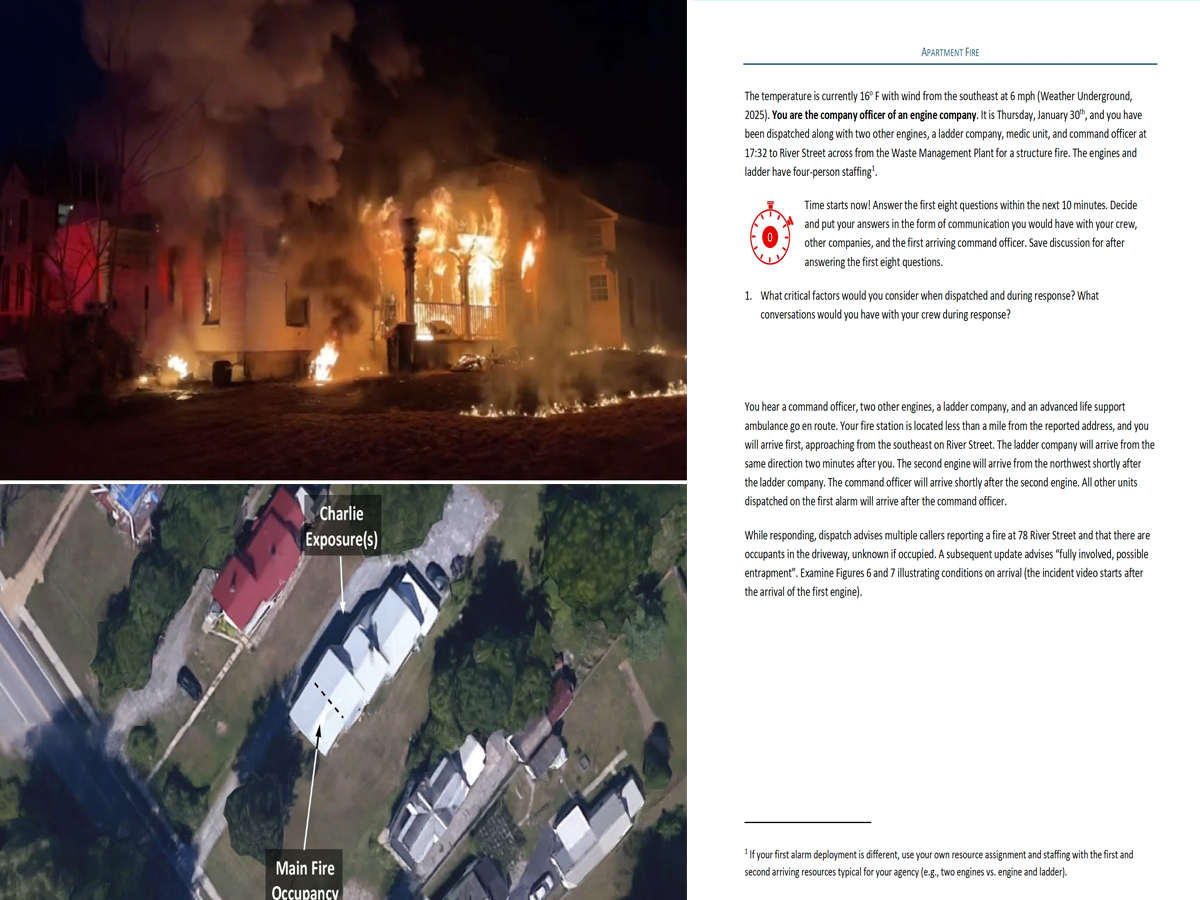
Excerpts from the author’s 10-Minute Training, featured in the April 2025 B Shifter Buckslip. Each drill is based on the principles of tactical decision games, a training method used by the military to practice essential decision-making skills.
What Makes 10-Minute Training Unique
Every month in the B Shifter Buckslip, I publish a 10-Minute Training based on TDGs to help expand your command competence. Firefighters and fire officers also engage in other learning activities, such as classroom or online training focused on strategy, tactics, and command, and watching fireground operations videos on social media, which often sparks discussions about what they would do differently.
What makes 10-Minute Training particularly effective compared with these other informal and formal learning activities? It is based on actual incidents. Incident video or realistic simulations grounded in real incident conditions place participants in a decision-making context that mimics real operations, rather than a hypothetical scenario:
- 10-Minute Training imposes a strict time limit to create time pressure similar to that experienced during incident operations, forcing participants to prioritize, commit, and act instead of engaging in extended deliberation.
- Participants respond to questions in the form of task and tactical orders, reinforcing clear command communications and giving deliberate practice in providing concise, actionable direction.
- Each scenario follows a structured sequence—decide > communicate > discuss—so that decision-making occurs before analysis and reflection, consistent with sound principles of experiential learning.
- Discussion questions connect directly to what actually occurred in the incident, giving participants the opportunity to engage with the incident narrative and develop vicarious experience through structured reflection rather than hindsight critique.
- Role-specific rubrics for IC No. 1 and IC No. 2 guide feedback, provide a consistent framework for evaluating decision-making and communication, and support development of tactical and command consistency.
10-Minute Training mirrors the cognitive requirements of decision-making during emergency incident operations. Its benefits are not limited to a single rank or role. Firefighters and fire officers can all develop increased competence depending on their current rank, their aspirations and the decisions that they are preparing to make.
Who Benefits & How?
The ancient Greek poet Archilochus is reputed to have stated, “We do not rise to the level of our expectations; rather, we fall to the level of our training.” Ask yourself: if you were confronted with a rapidly developing fire, trapped occupants or a mayday, would you be ready to make the call?
Firefighters and fire officers can use 10-Minute Training to prepare themselves to make critical foreground decisions. It’s also useful for firefighters preparing for promotion, for company officers and chief officers who want to improve their command skills and for training officers facing the challenge of developing effective training for their department.
These training materials are designed for self-study but are even more effective when used in a group. When facilitation focuses on developing understanding as well as decision-making skills, this training is effective at all levels, from the newest firefighter to the most experienced chief officer.
Watch for 10-Minute Training TDGs in the Buckslip each month and build your command competence through weekly practice. You can also click here to subscribe to free 10-Minute Trainings I release each week.
Reference
1. Anders Ericsson was a Swedish psychologist known for his research on expertise. He developed the concept of “deliberate practice,” showing that exceptional skill comes from focused, structured practice with feedback, not just time spent.
2. In 1985, Gary and colleagues Roberta Calderwood and Anne Clinton-Cirocco developed the Recognition-Primed Decision (RPD) model to explain how experienced fireground commanders could use their expertise to identify and carry out a course of action without having to generate and analyze a set of options.
The most critical assertion of the RPD model is that people can use experience to generate a plausible option as the first one they consider. The RPD model stemmed from Naturalistic Decision Making research and continues to be used today to study how experts make decisions across a variety of domains.
For more information: https://www.gary-klein.com/rpd

Ed Hartin, MS, EFO, FIFireE, CFO, retired as fire chief with East County Fire and Rescue in Camas, Wash., after a 50-year fire service career. Ed maintains an active international training and consulting practice and is a Blue Card instructor. He holds the Chief Fire Officer designation from the Commission on Professional Credentialing and is a Fellow of the Institution of Fire Engineers. Ed has undergraduate degrees in fire protection technology and fire service administration and a master’s degree in education. Since 2017, Ed has developed more than 450 10-Minute Trainings to provide ICs with deliberate practice to build competence.