





Why Blue Card Starts With Why: The clearer our purpose, the better the outcomes for our customers.
February 20, 2026Why BLUE CARD Starts with WHY
The clearer our purpose, the better the outcomes for our customers.
By John Vance
B Shifter Buckslip, Feb. 24, 2026
Every organization makes decisions. In the fire service, we propose new policies, introduce training programs, update tactics, invest in equipment and refine command processes. The real question is not whether we make decisions—it is how we make them. Blue Card emphasizes a foundational leadership discipline: Always start with why.
“Decision-making” reminds us that the customer must be at the center of every plan and decision. It challenges us to ask, “How does this affect Mrs. Smith?” That simple question reframes everything, forcing us as leaders and instructors to step outside internal preferences and focus on the people we ultimately serve.
“Starting with why” is not motivational language—it is operational clarity.
Does It Pass the Mrs. Smith Test?
Blue Card relies on standardized command, risk management and decision-making to produce predictable outcomes. But systems only matter if they improve service to the customer.
In public safety, it is easy to become internally focused. We spend hours debating terminology, simulations, certification processes and new tools. Those conversations are important—but if they drift away from improving outcomes for citizens, they lose purpose.
The principle of asking, “How does this affect Mrs. Smith?” keeps Blue Card grounded. Mrs. Smith represents the occupant trapped on the second floor, the family displaced by fire, and the community trusting its fire department to operate safely and effectively.
If a proposed training change improves clarity on the fireground, it benefits Mrs. Smith.
If a communication standard reduces freelancing and improves accountability, it benefits Mrs. Smith. If a new initiative exists only to add complexity without improving outcomes, we must critically examine why we are doing it.
Blue Card exists to improve command performance in the hazard zone. Every decision should reinforce that purpose.
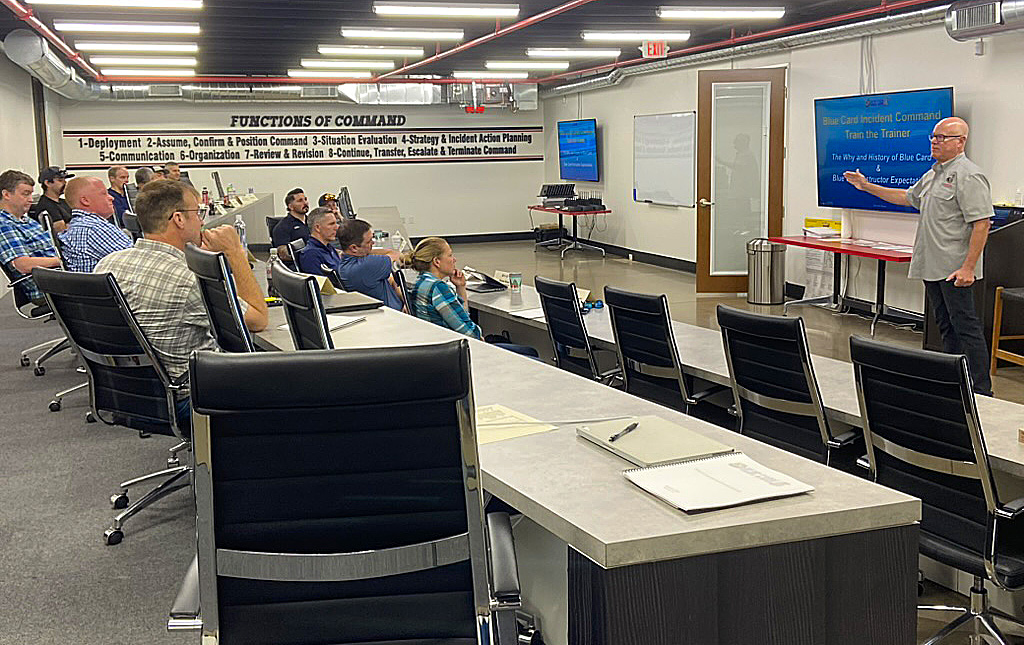
Blue Card lead instructors start every weeklong Blue Card train-the-trainer explaining the “why” behind the program.
Make Why the Focus & Everything Else Falls into Place
We often reference concepts outlined in Simon Sinek’s book “Start With Why.” The Golden Circle model reminds us that effective organizations think from the inside out:
Why do we exist?
How do we accomplish our mission?
What do we deliver?
Applied to Blue Card, it looks like this:
Why: To improve firefighter safety and customer outcomes through standardized incident command.
How: Through training, certifying and reinforcing consistent command functions and communication models.
What: Classes, simulations, workshops, certifications and continuing education modules.
The danger in any organization is answering a why problem with a “what” solution. In the fire service, that often looks like solving performance gaps with new equipment instead of addressing training, discipline, or communication breakdowns.
For Blue Card, it could mean adding more content when the real issue is inconsistent application. It could mean creating new materials when the need is for better instructor development. Without clarity on why, we risk layering solutions on top of unresolved root causes.
Starting with why forces us to slow down and diagnose before prescribing.
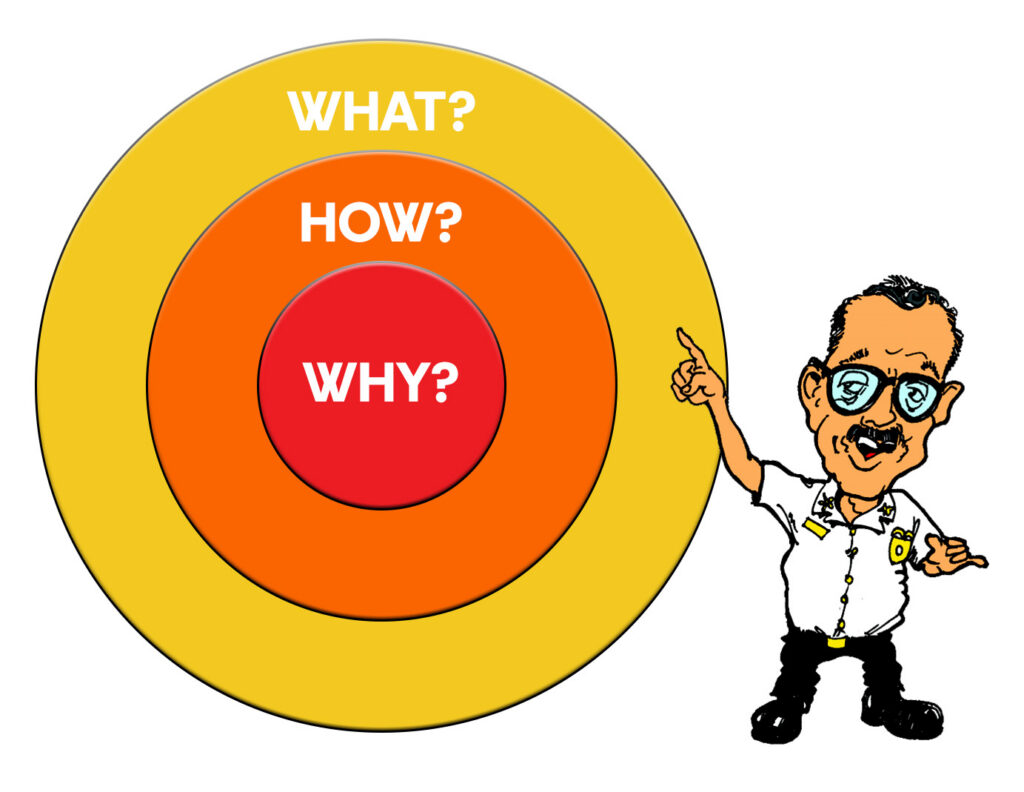
Sinek’s Golden Circle reminds us that the “why” is at the center of all we do.
Avoid the “Just for Us” Trap
When making decisions, I warn against implementing programs that are just for us. This is a powerful leadership filter.
In any training organization, there is a temptation to innovate for innovation’s sake: new modules, new terminology, new branding, new initiatives. We must guard against activity without alignment.
If a change does not improve customer service, command clarity, risk management, firefighter safety or survivability, we must question its value.
This does not mean resisting evolution. Blue Card has always embraced improvement. But improvement must serve a purpose. The discipline of why protects the integrity of the system.
Standardization without Purpose Falls Flat
Blue Card’s strength lies in standardization. Standard conditions produce standard actions, which create standard outcomes. But standardization is only sustainable when members understand why it matters.
Examples:
- When instructors explain not just what to say on the radio but why clear, calm, controlled communication reduces chaos, members commit to it.
- When officers understand why the transfer of command improves command rather than diminishes rank, they adopt the practice with confidence.
- When departments see why risk management models protect firefighters from becoming part of the problem, compliance becomes cultural.
Purpose drives discipline.
If members only hear the what (“This is how Blue Card does it”) without the why, adherence becomes fragile. When they understand the why (“This improves outcomes and keeps us from hurting ourselves”), buy-in deepens.
Purpose-Driven Leadership Prevents Impulse Decisions
The fire service evolves constantly. Research changes tactics. Standards update. Technology advances. Departments face budget pressures and shifting community expectations.
Without a clear why, organizations chase trends. With a clear why, they evaluate change through a disciplined lens.
For Blue Card, the questions become:
- Does this strengthen standardized command?
- Does it improve hazard-zone decision-making?
- Does it align with the mission of safer, more effective outcomes?
If the answer is yes, we move forward. If not, we reconsider.
Remember that incremental progress is better than no progress at all, but we must be cautious about change for change’s sake. That philosophy aligns directly with Blue Card’s long-game approach: deliberate, thoughtful evolution that benefits customers and supports organizational stability
Seek Commitment over Compliance
Ultimately, starting with why is a leadership obligation.
Blue Card instructors, incident commanders and department champions must consistently communicate purpose. When launching a class, the why must be clear. When updating materials, the why must be clear. When reinforcing command discipline, the why must be clear.
Members are far more likely to commit to standardized communications and disciplined command transfers when they understand the mission behind it.
Leaders who skip the why compel compliance. Leaders who explain the why inspire commitment.
The why must sit at the center of our decision-making. That means leaders cannot hide behind tradition or convenience. Every major decision should be defensible in terms of purpose and customer impact.
Empowerment Through Clarity
Blue Card is not about rigid control—it is about structured clarity. Clearly defining the why empowers decentralized decision-making. When firefighters understand the mission and command framework, they can operate confidently within it. When officers understand the purpose behind the Eight Functions of Command, they can apply them under stress without hesitation.
Discipline Protects Trust
Ultimately, starting with why protects something far more valuable than operational efficiency: trust. Departments adopting Blue Card know the system is not built around personality or ego—it is built around improving outcomes. That consistency builds credibility across agencies and regions.
The public trusts the fire service to act competently and ethically. Firefighters trust leaders to make decisions grounded in mission, not politics. Instructors trust that the system they deliver is purposeful and aligned.
By continually asking why, Blue Card reinforces its commitment to serving the customer, protecting firefighters and advancing the profession with integrity.
Why we start with why is simple:
Because it keeps the mission clear.
Because it filters out ego.
Because it aligns resources with purpose.
Because it protects standardization.
Because it improves outcomes.
In the end, Blue Card does not exist to create classes or certifications. It exists to improve command performance in the hazard zone and deliver better results for the people we serve.
Starting with why ensures we never forget that.
John Vance recently retired as a fire chief after 22 years in the front office. He is currently a battalion chief with the Chanhassen (Minn.) Fire Department; he has been a chief officer since 2002. He is a proud Blue Card lead instructor and an accredited chief officer through the Center for Public Safety Excellence. John has a bachelor’s degree in fire service management from Southern Illinois University and a certificate in executive management from the University of Notre Dame. He is the host of the B Shifter Podcast.